
· ARUM Team · LED Knowledge
What Is 48V LED Strip? Why It's the New Trend for Commercial Lighting in 2026
Get to know 48V LED strips — the technology solving voltage drop problems for runs over 20 meters. Who needs it and why 2026 is the year it matters.
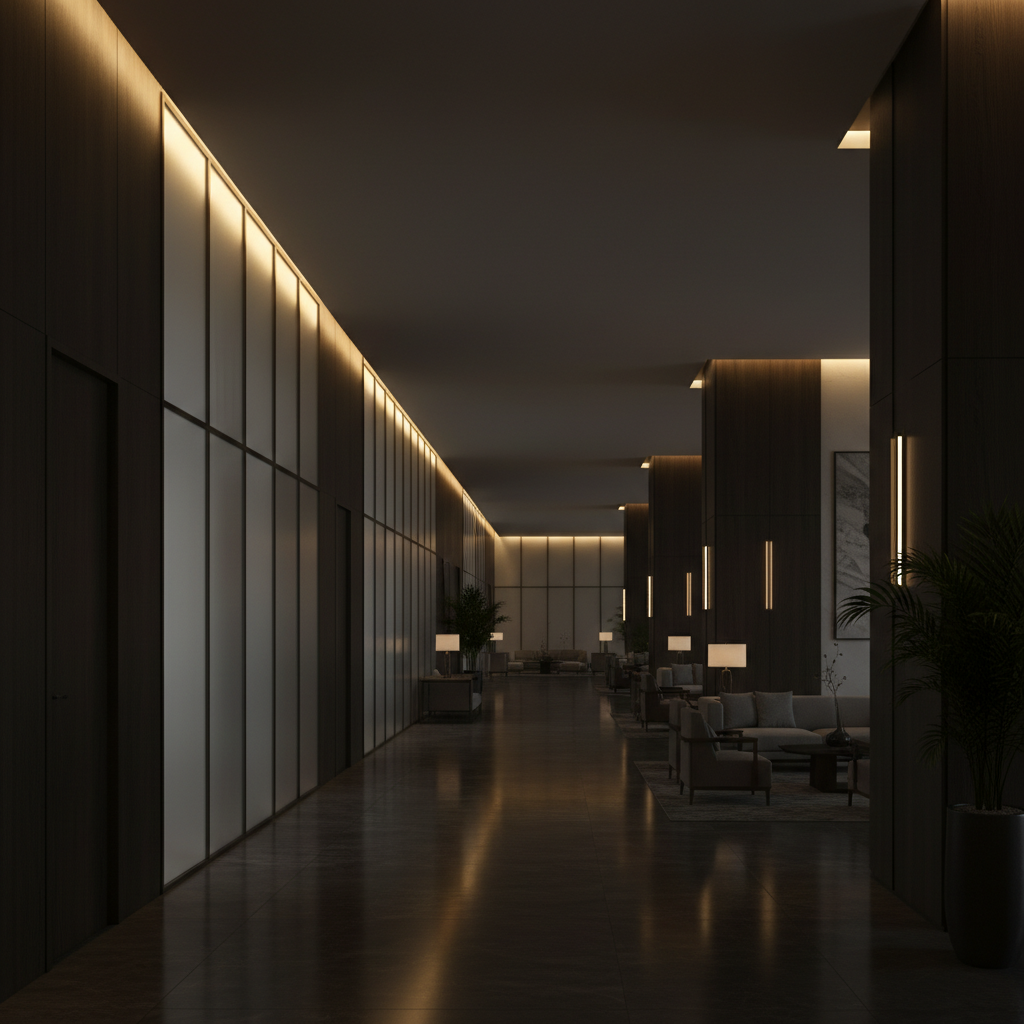
In 2026, the commercial LED strip market is going through a significant shift — from the 24V standard that has dominated for years toward 48V DC, which is increasingly appearing in commercial, hospitality, and architectural lighting projects. This article explains what 48V LED strips are, why they’re gaining traction, and who should actually care.
What Is a 48V LED Strip?
A 48V LED strip is a flexible LED strip designed to operate at 48V DC instead of the traditional 12V or 24V. The internal structure is still COB or SMD, but the circuit layout changes — LED chips are arranged in a longer series configuration so that each chip still sees its normal forward voltage, but the total strip voltage is higher.
The result: lower current. At the same power output, a 48V system draws only half the current of 24V and one-quarter of 12V.
Formula: I = P ÷ V
- 12V system, 120W → 10A
- 24V system, 120W → 5A
- 48V system, 120W → 2.5A
How 48V Solves the Voltage Drop Problem
Voltage drop (dim light at the far end of a run) is the biggest enemy of long LED strip installations. The formula is:
V_drop = I × R
Drop is directly proportional to current. Less current = less drop. Switching from 24V to 48V at the same power halves the current, which halves the voltage drop.
More importantly, consider drop as a percentage of source voltage:
| System | 3V drop (example) | % of source | Visible dimming |
|---|---|---|---|
| 12V | 3V | 25% | Severe, clearly visible |
| 24V | 3V | 12.5% | Slight |
| 48V | 3V | 6.25% | Essentially invisible |
In practice:
- 12V — starts dropping noticeably after ~3–5m
- 24V — starts dropping noticeably after ~5–10m
- 48V — handles 15–25m on a single run without any visible issue
Advantages of 48V Systems
1. Long runs without circuit splitting A 48V system can handle 20+ meter single runs without dual feeding or breaking into multiple segments. Saves installation time and wiring materials.
2. Smaller wire gauge Same power, lower current — AWG 18 wire works where 24V would require AWG 14–16. Cheaper materials and easier to route.
3. Higher efficiency 48V power supplies run at 90–95% efficiency compared to 85–92% for 24V. Less energy wasted as heat.
4. Less heat in wiring P_loss = I² × R — halving the current reduces wire heat losses by 75%.
5. Built for commercial scale Hotels, restaurants, shopping centers with strip runs of 30–100 meters benefit enormously from 48V.
Limitations of 48V
1. Power supplies are harder to find and more expensive 48V DC PSUs aren’t yet widely stocked in Thailand, and cost 40–60% more than 24V equivalents.
2. Controllers and dimmers must be 48V-rated You can’t use 24V controllers with a 48V system directly.
3. Not suited for homes For residential runs under 10 meters, 24V is still more cost-effective.
4. Safety note 48V is still within SELV (Safety Extra-Low Voltage) range, but it’s closer to the upper limit than 24V. In spaces where children might touch exposed components, 24V is safer.
5. Strip availability As of 2026, 48V strips are just starting to appear in the Thai market. Still limited range, and 20–30% more expensive per meter than 24V.
Who Should Use 48V?
Ideal for:
- Commercial / Hospitality — hotels, resorts, spas with long corridor runs
- Retail / Shopping — long cove runs in atriums and large stores
- Architectural Lighting — building facades and high-rise edges
- Large Meeting Rooms / Ballrooms — cove runs over 30 meters
- Outdoor Commercial — signage and landscape lighting over long distances
- Industrial — factories and warehouses with long ceiling lines
Not suited for:
- Typical home installations (24V is better value)
- Single-room cove lighting
- Tight budgets
- Areas children can easily access
Why 2026 Is the Inflection Point
Several factors are converging to push 48V into the mainstream:
- 48V PSU prices are falling — driven by data center demand and USB-PD technology, bringing 48V PSU costs closer to 24V
- Ethernet PoE++ (IEEE 802.3bt) uses 48–57V DC, expanding infrastructure familiarity
- EV ecosystem — electric vehicles and micro-mobility use 48V systems, growing the component economy
- Green building standards (LEED, EDGE) require minimizing energy loss in lighting systems
- Commercial clients want long runs without multiple circuits — reducing labor costs
Summary
48V LED strip technology isn’t new, but 2026 is the first year it’s truly accessible in Thailand. For commercial projects with long runs, 48V will save installation time, material costs, and ongoing electricity bills. For standard home use, 24V remains the smarter choice.
Arumstores is preparing COB LED 48V strips for the commercial market in mid-2026, alongside matching 48V power supplies and controllers. If you have a large project that could benefit from 48V, contact our team for early consultation.