
· ARUM Team · LED Knowledge
24V vs 48V LED Strip — Which Should You Choose? A Detailed Comparison
A thorough comparison of 24V and 48V LED strips. What's the difference, which one suits which project, and real calculation examples to help you decide.
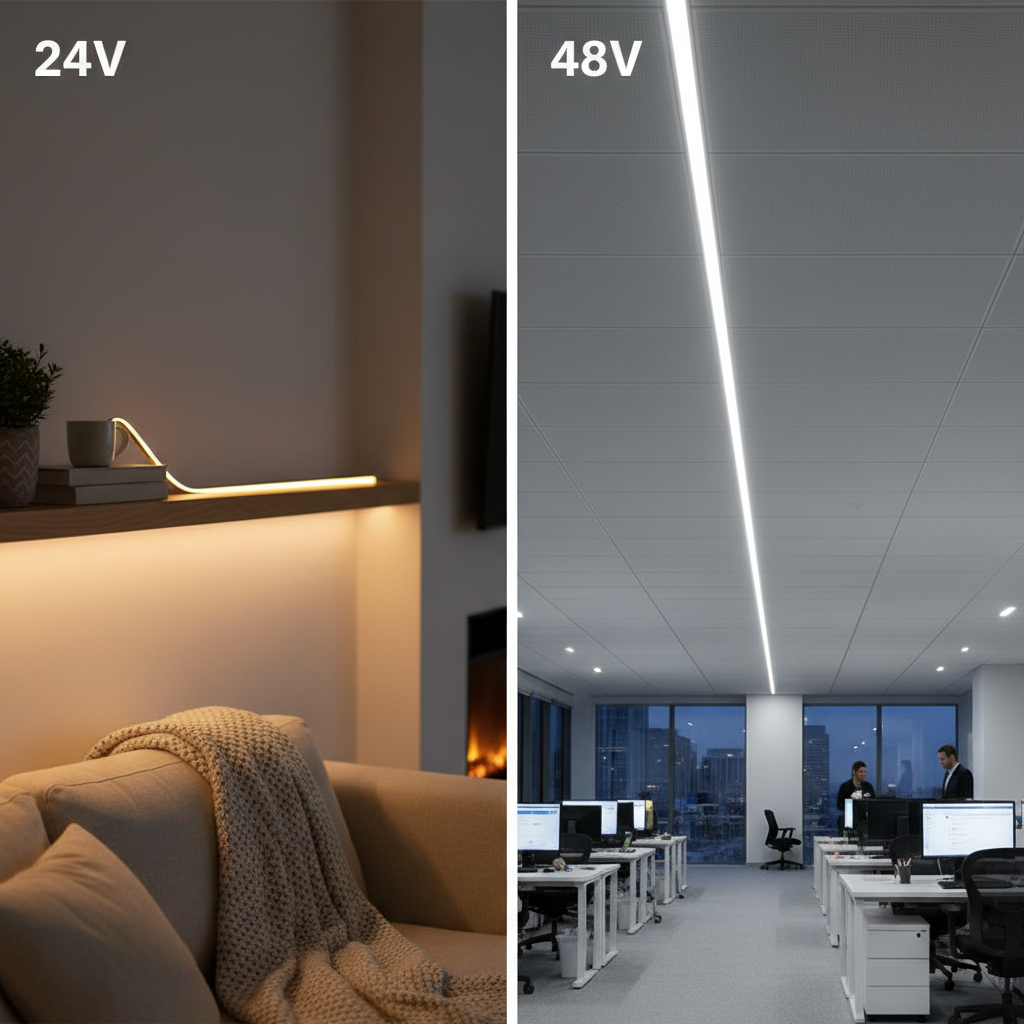
As 48V LED strips become a genuine market option in Thailand, the most common question we hear is: “Should I switch from 24V to 48V?” The honest answer is: it depends on your project. This article compares both systems in detail with real calculation examples so you can make the right call.
Basic Comparison
| Spec | 24V LED Strip | 48V LED Strip |
|---|---|---|
| Voltage | 24V DC | 48V DC |
| Current at 120W | 5A | 2.5A |
| Max run length (single feed) | 5–10 m | 15–25 m |
| Voltage drop % at equal distance | 12.5% | 6.25% |
| Wire gauge required | AWG 16–18 | AWG 18–20 |
| PSU efficiency | 85–92% | 90–95% |
| PSU availability | Widely available | Growing, still limited |
| Controller/Dimmer options | Widely available | Limited |
| Strip price per meter | Standard | 20–30% higher |
| PSU price | Standard | 40–60% higher |
| SELV safety rating | Excellent | Good (near upper limit) |
| Residential use | Best choice | Over-specified |
| Long commercial runs | Adequate | Ideal |
Pros and Cons of Each System
24V LED Strip
Advantages:
- Complete ecosystem — PSU, controllers, dimmers, channels, accessories available from every brand
- Lower cost — strips and components are cheaper overall compared to 48V
- Safest for home use — SELV standard, contact won’t cause electric shock
- Any installer can handle it — no specialized knowledge required
- Fine cut increments — every 2.5–5 cm
- Right for 80% of home projects
Disadvantages:
- Voltage drop at the end of runs when exceeding 5 meters — requires dual feed
- Larger wire needed when the PSU is far from the strip
- Circuit splitting required for runs over 20m — multiple PSUs or re-injection points
- Higher labor cost for complex installations
48V LED Strip
Advantages:
- Single run up to 15–25 meters without splitting circuits
- Thinner wire — saves material cost and installation time
- Higher efficiency — up to 90–95% vs 85–92% for 24V
- Less heat in wiring — wire power loss drops by 75% (I² × R with 2.5A vs 5A)
- Ideal for commercial-scale projects
Disadvantages:
- Limited ecosystem — controllers and dimmers are harder to find
- 30–50% higher upfront cost for strip and components
- Over-specified for home use — paying premium for no real benefit
- Requires knowledgeable installer — wrong design still causes problems
Real-World Calculations: 3 Scenarios
Scenario 1: Living Room Cove Lighting — 8 Meters
COB 12W/m strip, total power = 96W
24V System:
- Strip 8m × ฿400 = ฿3,200
- PSU 24V 150W = ฿900
- AWG 18 wire 3m = ฿150
- Total: ฿4,250
- Current: 4A, voltage drop: ~8% (acceptable)
48V System:
- Strip 8m × ฿520 = ฿4,160
- PSU 48V 150W = ฿1,400
- AWG 20 wire 3m = ฿120
- Total: ฿5,680
- Current: 2A, voltage drop: ~4%
Winner: 24V — ฿1,430 cheaper, and voltage drop isn’t a problem at this distance
Scenario 2: Hotel Corridor — 30 Meters
COB 15W/m strip, total power = 450W
24V System:
- Strip 30m × ฿450 = ฿13,500
- PSU 24V 300W × 2 (circuit split required) = ฿3,000
- AWG 14 wire from 2 feed points × 10m = ฿1,000
- Dual feed + junction boxes = ฿800
- Extra labor for 2-circuit setup = +฿2,500
- Total: ฿20,800
- Must verify voltage drop at 2 sections
48V System:
- Strip 30m × ฿580 = ฿17,400
- PSU 48V 600W × 1 = ฿2,800
- AWG 16 wire × 5m = ฿400
- Total: ฿20,600
- Single circuit, no voltage drop issues
Winner: 48V (marginally) — similar cost but simpler to install, longer lifespan, fewer problems
Scenario 3: Building Facade — 50 Meters
COB 20W/m strip, total power = 1,000W
24V System:
- Requires 5 separate circuits, 10m each
- PSU 24V 300W × 4 = ฿8,000
- Strip 50m × ฿500 = ฿25,000
- Wiring, junctions, labor = ฿8,000
- Total: ฿41,000
- Maintenance complexity across 5 circuits
48V System:
- 2–3 circuits (20–25m each)
- PSU 48V 600W × 2 = ฿7,200
- Strip 50m × ฿650 = ฿32,500
- Wiring, junctions, labor = ฿3,500
- Total: ฿43,200
- Simpler maintenance
Winner: 48V — similar total cost but lower installation labor, higher stability, reduced downtime
Decision Guide
Choose 24V when:
- Home installation, runs under 10 meters per circuit
- Budget is the primary concern
- You need a wide variety of dimmers and controllers
- Children can access the installation
- Installer doesn’t have specialized training
Choose 48V when:
- Commercial or hospitality projects
- Individual runs of 15+ meters
- Want to reduce installation labor costs
- Long-term efficiency matters
- Budget for specialized components is available
- Minimizing maintenance downtime is important
The simple rule:
- ≤ 10m → 24V
- 10–15m → Well-designed 24V or 48V
- ≥ 15m → 48V is better
- ≥ 25m → 48V is almost mandatory
Will 48V Replace 24V?
Short answer: Not anytime soon in the residential market. 48V won’t displace 24V for home use because:
- 24V is still the most cost-effective for shorter runs
- The 24V ecosystem has far more accessories and options
- Installers and homeowners are already comfortable with it
But 48V will take over the mid-to-high commercial market within 3–5 years and become the standard for hotels, shopping centers, and office buildings.
Summary
24V and 48V aren’t in competition — they each excel at different project scales. Homes go with 24V, long commercial runs go with 48V, and for anything in between, look at the run length and budget.
Arumstores is preparing 48V COB LED strips for the commercial market in 2026. For now, our 24V COB LED strips remain the top choice for residential and small hospitality projects. If you have a large project that could benefit from 48V, contact our team for a consultation.