
· ARUM Team · LED Knowledge
Why AC 220V Lighting Doesn't Have Voltage Drop Problems — What Every Installer Should Know
Explains why Neon Flex 220V can run 50 meters with no dimming at the far end, while 24V DC strips struggle past 10 meters. The physics of AC vs DC explained clearly.
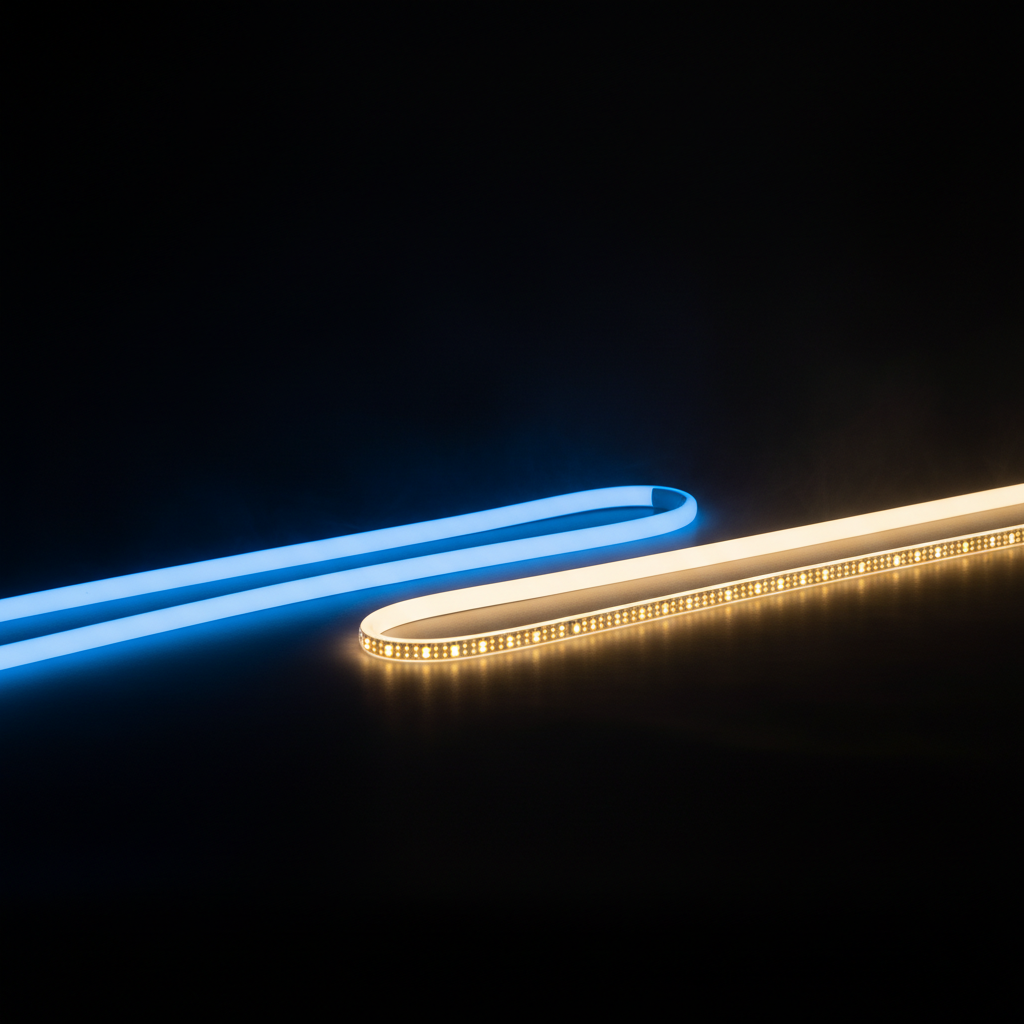
If you’ve ever battled the dimming-at-the-end problem with a long 24V LED strip, then seen a Neon Flex 220V installation running 50 meters with perfectly even brightness throughout — you might have wondered why. The answer is basic physics, and understanding it will help you make smarter decisions about which type to use where.
AC 220V vs DC 24V: The Key Difference
AC 220V — Standard household current in Thailand, alternating current at high voltage. Consider a 50-meter Neon Flex 220V strip consuming 400W:
- Current = P/V = 400/220 = 1.8A
DC 24V — Low-voltage direct current. Consider a 10-meter COB strip at 120W:
- Current = 120/24 = 5A
Note: the AC system is longer and draws more total power, yet its current is less than half of the DC system. This is the key to understanding voltage drop behavior.
Why Lower Current Means Less Voltage Drop
Voltage drop formula: V_drop = I × R
Drop is directly proportional to current. Lower current = lower drop. But more importantly, consider drop as a percentage of source voltage:
- DC 24V drops 5V at the far end: 5/24 = 21% → strip visibly dims by ~40%
- AC 220V drops 5V at the far end: 5/220 = 2.3% → human eyes can barely detect this
This is why AC 220V installations appear to have no voltage drop problem — they do mathematically, but the percentage is too small to perceive visually. 24V DC systems drop the same absolute voltage but it represents a far larger fraction of the source.
Practical Limits
- 12V DC — perceptible dimming starts around 3–5 meters from the injection point
- 24V DC — perceptible dimming starts around 5–10 meters
- 48V DC — visible only after 15–25 meters (see our 24V vs 48V guide for details)
- 220V AC — visible only beyond 100+ meters in a single run; effectively zero for typical applications
Pros and Cons of Each System
AC 220V (Neon Flex 220V, COB 220V)
Advantages:
- Run 50–100 meters continuously without voltage drop concerns
- No separate DC power supply required — plug directly into wall via included rectifier
- Lower component cost for long outdoor runs
- Ideal for outdoor perimeter lighting, building outlines, long path lighting
Disadvantages:
- 220V contact is dangerous — installation must be done carefully; keep exposed conductors covered
- Dimming is more complex — requires TRIAC dimmer
- Cut intervals every 50–100cm only (much coarser than DC strips at every 2.5–5cm)
- Flickers at 100Hz (twice the 50Hz line frequency) — some people can detect this in peripheral vision
DC 12V/24V (COB Strip, LED Strip)
Advantages:
- Safe to touch — SELV voltage, no shock hazard
- Smooth dimming with standard PWM dimmers
- Fine cut increments (every 2.5–5cm) for precise installations
- Ideal for interior applications including cove lighting, furniture, and cabinetry
Disadvantages:
- Requires separate power supply
- Run length limited before requiring dual-feed or circuit splitting
- Efficiency loss in AC-to-DC conversion (~10–15%)
- Higher total component cost for long runs (strip + PSU + wiring)
Choosing Between AC and DC
Use AC 220V (Neon Flex) when:
- Outdoor runs over 10m — building outlines, perimeter fencing, garden paths
- Long signage or decorative runs where plugging a PSU is impractical
- Projects without dimming requirements
- Budget for long outdoor runs (no PSU cost)
Use DC 24V (COB Strip) when:
- Interior installations — cove lighting, furniture, cabinets, under-counter
- Cove lighting under 10m per circuit
- Dimming or color temperature adjustment is needed
- Safety is paramount (children in the space, accessible locations)
Important Safety Notes for AC 220V
Even though AC 220V doesn’t have a visible voltage drop problem, it has specific rules:
- Always cut at the designated intervals only — cutting between marks on AC strips can cause complete circuit failure or short circuits
- Don’t exceed 100 meters in a single continuous run — while percentage drop is small, cumulative resistance does eventually cause visible dimming
- Always use the provided rectifier — never connect Neon Flex 220V directly to mains without the included converter
- Never expose metal contacts — 220V contact can be fatal
Summary
AC 220V doesn’t “have no voltage drop” — it has voltage drop that’s too small to see, because the source voltage is so much higher. DC 24V has the same absolute drop, but it’s a significant fraction of the total. Match the technology to the application: long outdoor runs → AC 220V; indoor precision lighting → DC 24V.
Browse Neon Flex 220V and COB Strip 24V at Arumstores. View all products.