
· ARUM Team · LED Knowledge
What Is Voltage Drop? Why Your LED Strip Is Dimmer at the Far End
Understand voltage drop in DC LED systems — what causes it, how to measure it, and the right design choices to eliminate it from the start.
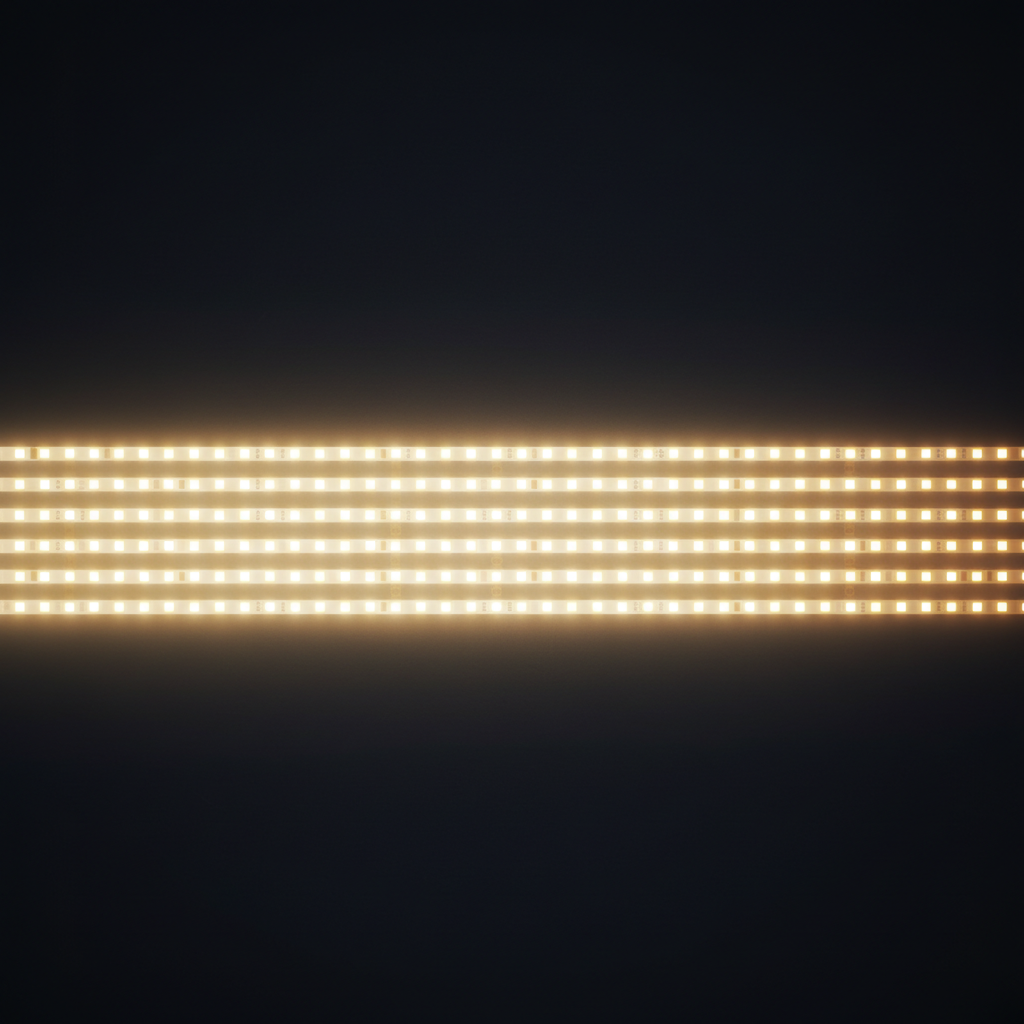
If you’ve ever installed a long LED strip and noticed the end is noticeably dimmer than the beginning — that’s not a faulty strip. It’s a physics phenomenon called voltage drop, and it can be completely prevented once you understand how to design around it.
What Is Voltage Drop?
Voltage drop is the reduction in electrical pressure (voltage) as current travels along a conductor. Even copper wire has some resistance, and as current flows through it, a portion of the energy converts to heat — leaving less voltage available at the far end.
Basic formula: V_drop = I × R (voltage drop = current × resistance)
In 12V/24V DC LED strip systems, this problem is amplified because:
- Current is relatively high (often 5A or more)
- The copper traces on LED strip PCBs are thin — resistance adds up quickly
- Runs over 5 meters start showing visible drop
How It Works: A Real Example
Take a 24V COB LED strip drawing 12W/m over a 10-meter continuous run:
- Total current = 120W ÷ 24V = 5A
- Resistance of the copper traces ≈ 0.5–1Ω per 10m
- Voltage drop at the far end = 5A × 1Ω = 5V
- Remaining voltage at far end = 24 − 5 = 19V (21% drop)
A strip designed for 24V receiving only 19V will produce approximately 40% less light — very visible dimming at the end of the run.
This effect is roughly twice as severe on 12V systems, since you need twice the current to deliver the same power at half the voltage. This is why 24V is always recommended for longer runs.
How to Check for Voltage Drop
1. Use a multimeter — measure DC voltage at both the start and end of the strip while powered
- < 3% difference: normal
- 3–10% difference: acceptable, slight dimming
10% difference: requires correction
2. Visual comparison — photograph both ends side by side. If the far end is clearly dimmer, you have a problem.
3. Temperature check — if the near end is significantly hotter (5–10°C more), too much current is concentrating there.
Solutions for Voltage Drop
Solution 1: Dual Feed Power the strip at both ends — connect positive and negative from the PSU to both the start and the end of the strip. This halves the distance current must travel and reduces voltage drop by approximately 75%.
Solution 2: Split into shorter runs Divide a 15-meter run into three 5-meter segments, each with its own feed from the PSU. Current never travels through more than 5 meters of strip trace.
Solution 3: Use larger feed wire The wire from your PSU to the strip’s connection point also adds resistance. Guidelines:
- Run ≤ 3m → AWG 18 (1.0mm²)
- Run 3–6m → AWG 16 (1.5mm²)
- Run 6–10m → AWG 14 (2.5mm²)
Solution 4: Switch from 12V to 24V For longer runs, 24V strips use half the current of equivalent 12V strips, cutting voltage drop in half.
Solution 5: Use Constant Current strips These have built-in IC regulation that compensates for voltage drop. Very effective but 50–100% more expensive. Best for mission-critical installations.
Design for Success from the Start
Designing correctly costs less than fixing problems later:
- Don’t run a single strip beyond 5m without a mid-point power injection (for 24V; 3m for 12V)
- Position the PSU as close to the strip as possible to minimize feed wire distance
- Slightly over-size your feed wire — small additional cost, major reliability benefit
- Choose strips with heavier copper (2-oz copper PCB or higher) — half the trace resistance of standard strips
- Size the PSU with 25% headroom — a PSU at 100% load has unstable output voltage
Summary
Voltage drop is unavoidable physics, but it’s entirely manageable with the right design. Choose 24V over 12V, power from multiple points, and size your wiring correctly. With these practices, you can run 20–30 meter LED installations without any visible dimming at the far end.
Interested in COB strip lights and quality power supplies with design guidance? Contact Arumstores.