
· ARUM Team · LED Knowledge
RGB vs RGBW vs RGB+CCT — What's the Difference? Choosing the Right Color LED Strip
RGB, RGBW, and RGB+CCT look similar but perform very differently. This guide explains each type, their ideal use cases, and how to pick the right one for your project.
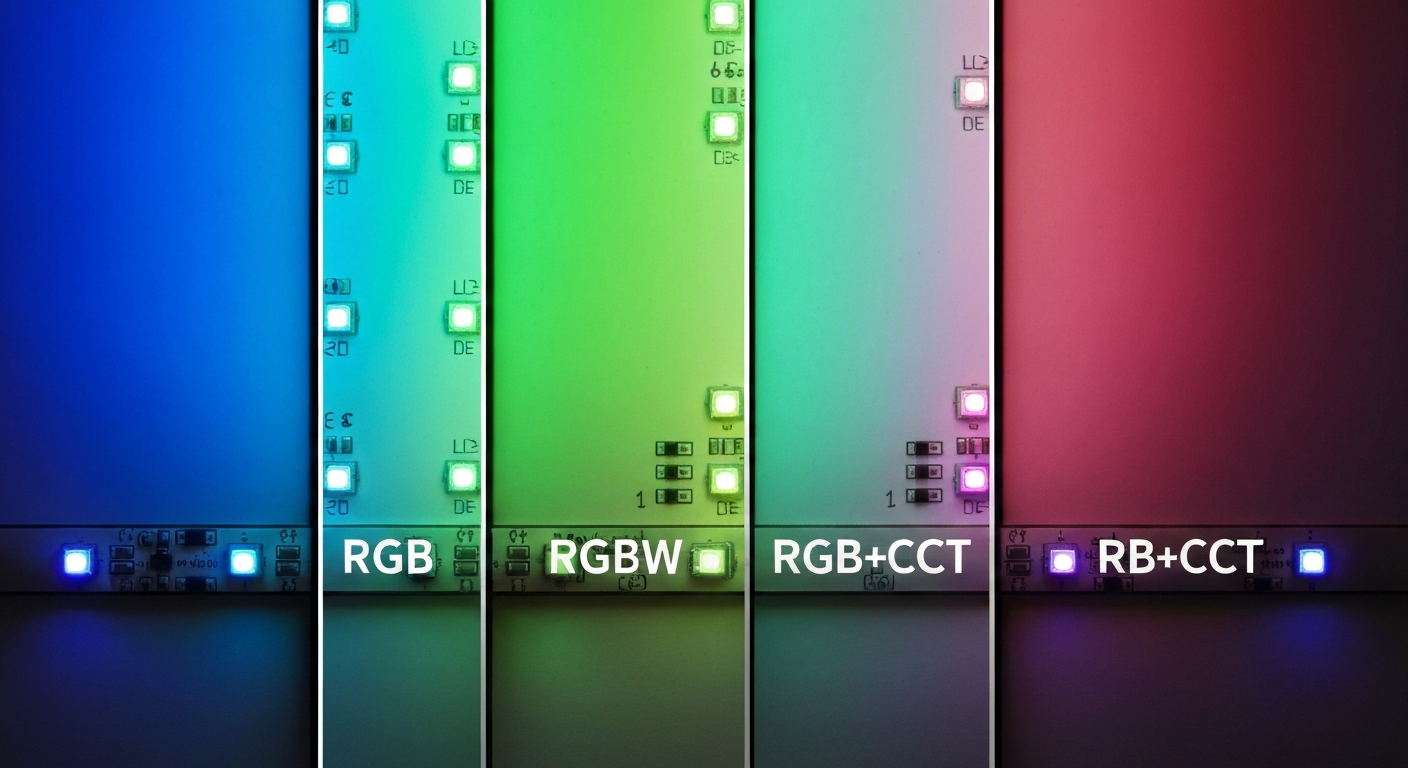
When you’re shopping for color LED strips and you see three options — RGB, RGBW, and RGB+CCT — it’s easy to be confused about what’s actually different. All three can display colors. But their ability to produce white light and adjust color temperature differs significantly, and that’s what determines which one is right for you.
What Is RGB?
RGB stands for Red + Green + Blue — the three primary colors that combine to produce millions of color shades.
Every LED on an RGB strip contains three color chips (commonly SMD 5050). A controller adjusts each color channel independently to mix any hue you want.
RGB Advantages
- Most affordable of the three types
- Widely available with a huge range of compatible controllers
- Great for vivid, saturated colors and dramatic effects
RGB Limitations
- White light produced by mixing RGB is typically not true white — it often has a purple or blue tint
- Low CRI — not suitable for spaces that need accurate, functional lighting
- If white light is your primary need, RGB is the wrong choice
When to Use RGB
- Entertainment spaces — gaming rooms, bars, cafes
- Light shows — where frequent color changes are the point
- Accent lighting — hidden strips where you only see the glow
- Budget-conscious color projects
What Is RGBW?
RGBW adds a dedicated White chip alongside the RGB chips — four chips total in one package.
The key difference: white light in RGBW comes from a real white LED chip, not from mixing colors. This produces cleaner, higher-CRI white light that’s actually usable for everyday lighting.
The most common RGBW chip is the SMD 5050 RGBW — R, G, B, and W in a single package.
RGBW Advantages
- Clean, bright white light with real usability
- Full RGB color capability remains intact
- Works as both a mood light and a functional white light
- Suitable for spaces that need both modes
RGBW Limitations
- More expensive than standard RGB
- Controller must support 4 channels (RGBW)
- White color temperature is fixed (either Warm White or Cool White — not both)
When to Use RGBW
- Bedrooms and living rooms where you sometimes want color, sometimes want clean white
- Restaurants and retail that want flexible ambiance
- Cove lighting or indirect lighting where the strip is partially visible
- Any space that needs both white functionality and color capability
What Is RGB+CCT?
RGB+CCT is the most capable of the three — it combines RGB color chips and CCT (Correlated Color Temperature) chips that can shift from warm white to cool white.
In simple terms: full RGB color range plus high-quality white light that’s tunable from 2700K all the way to 6500K — all in a single strip.
RGB+CCT Advantages
- Everything in one strip — colors, white, and tunable color temperature
- Adjust white light independently from 2700K (warm) to 6500K (cool)
- Highest CRI of the three types
- Maximum flexibility for every lighting scenario
RGB+CCT Limitations
- Most expensive option
- Controller must support 5 channels (R+G+B+WW+CW)
- More complex installation — wiring must be correct
- Higher power consumption (more chips per meter)
When to Use RGB+CCT
- Premium projects requiring maximum flexibility
- Smart home setups controlled via app with full feature access
- Multi-purpose spaces used as both a home office, living room, and entertainment area
- Anyone who wants to buy once and never need to upgrade
Side-by-Side Comparison
| Feature | RGB | RGBW | RGB+CCT |
|---|---|---|---|
| RGB color output | ✓ | ✓ | ✓ |
| Clean white light | ✗ | ✓ | ✓ |
| Tunable white temperature | ✗ | ✗ | ✓ (2700K–6500K) |
| CRI | Low | Medium | High |
| Number of channels | 3 | 4 | 5 |
| Cost | Budget | Mid | Premium |
| Complexity | Simple | Medium | High |
How to Choose: 3 Questions to Ask Yourself
1. Do you need functional white light?
- No → RGB is enough, and it’s the most affordable
- Yes → Move to RGBW or RGB+CCT
2. Do you need to adjust the warmth or coolness of the white?
- No → RGBW covers all your needs
- Yes → RGB+CCT is the only option
3. What’s your budget and tolerance for complexity?
- Low budget, simple setup → RGB
- Mid budget → RGBW
- Full features at any cost → RGB+CCT
Controller Compatibility
The controller must match the strip type. Check the full controller range at Arumstores to confirm channel compatibility:
- RGB Controller — 3 channels (R/G/B)
- RGBW Controller — 4 channels (R/G/B/W)
- RGB+CCT Controller — 5 channels (R/G/B/WW/CW)
Using the wrong controller type will either limit functionality or prevent the strip from working correctly.
Summary
| If you… | Choose |
|---|---|
| Want colors, budget-friendly | RGB |
| Want both colors and quality white light | RGBW |
| Want everything, maximum flexibility | RGB+CCT |
There’s no universally “best” option — the best one is the one that matches your actual use case and budget.
Browse all LED strips at Arumstores to compare specs, or reach out to our team for a recommendation tailored to your project.