
· ARUM Team · LED Knowledge
What Is IP Rating? IP20, IP65, IP67 — Choosing the Right LED Strip for Every Location
Confused by IP20, IP65, and IP67 on LED strip specs? This guide explains the IP rating system clearly and shows you exactly which rating to use in each location.
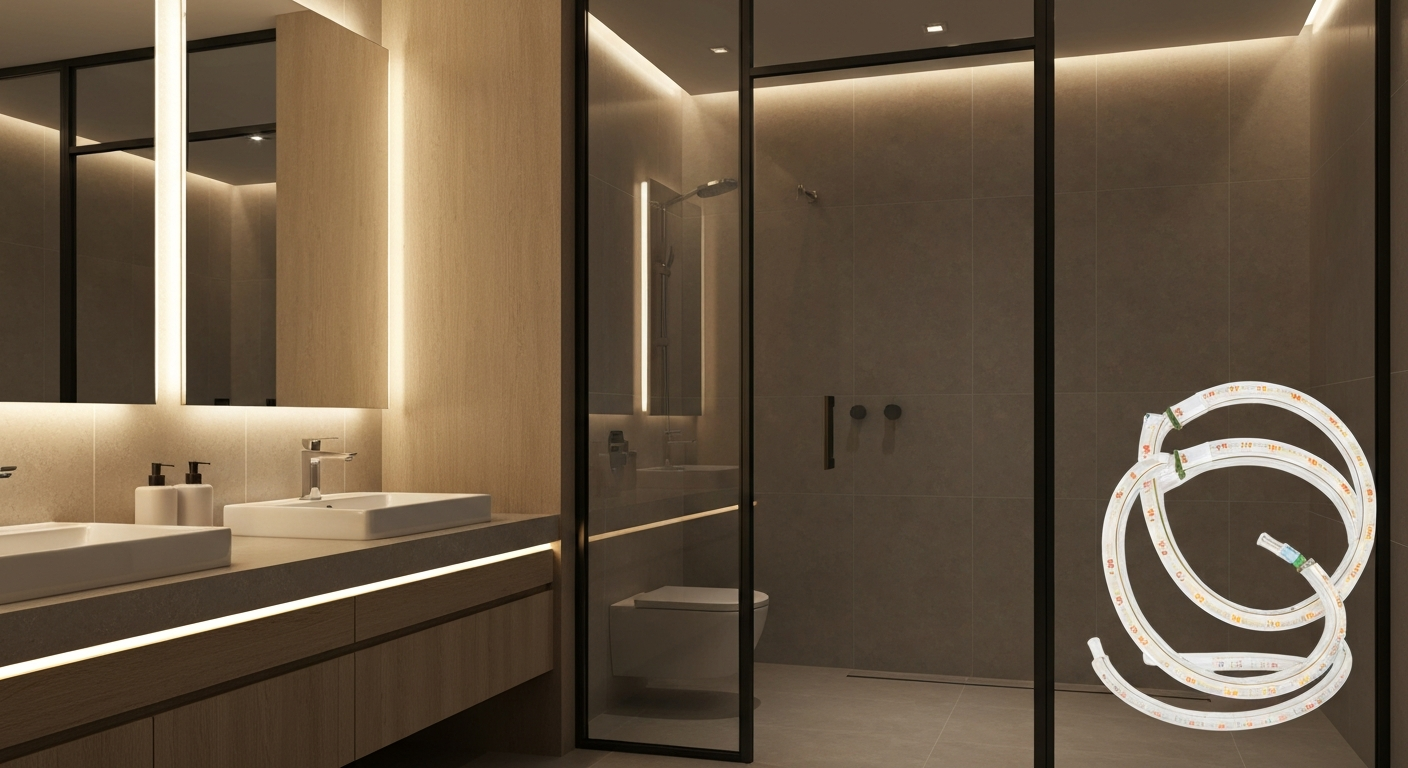
When choosing an LED strip for your home, bathroom, or outdoor space, you have probably noticed ratings like “IP20”, “IP65”, or “IP67” in the product specs. You may have wondered what those numbers actually mean — and whether they matter.
They do. IP Rating is a classification of how well a device is protected against dust, moisture, and other foreign objects. Choosing the right IP rating for your location will keep your LED strip working reliably for years.
This guide explains the IP rating system from the ground up, then maps each rating to the locations where it belongs.
What Is IP Rating?
IP stands for Ingress Protection — an international standard (IEC 60529) that describes how well an electrical device is sealed against:
- First digit (0–6) = protection against solid particles (dust and debris)
- Second digit (0–8) = protection against liquids (water and moisture)
For example, IP65 means “completely dust-tight (6) and protected against water jets (5)“.
Understanding Each Digit
First Digit — Solid Particle Protection
| Rating | Meaning | Notes |
|---|---|---|
| 0 | No protection | Fully open |
| 1 | Large objects | Hand cannot enter |
| 2 | Fingers | Objects smaller than 12 mm |
| 3 | Tools and wires | Objects smaller than 2.5 mm |
| 4 | Small wires | Objects smaller than 1 mm |
| 5 | Dust partial | Dust may enter slightly, but not enough to cause harm |
| 6 | Dust-tight | Completely sealed against dust |
Second Digit — Liquid Protection
| Rating | Meaning | Notes |
|---|---|---|
| 0 | No protection | Cannot be near water |
| 1 | Vertical drips | Light drips from directly above |
| 2 | Drips at 15° | Slightly angled drip |
| 3 | Spraying water | Rain at any angle up to 60° |
| 4 | Splashing water | Water splashed from any direction |
| 5 | Water jets | Low-pressure jets from any direction |
| 6 | Powerful jets | High-pressure jets |
| 7 | Temporary immersion | Submerged up to 1 m for 30 minutes |
| 8 | Continuous immersion | Submerged beyond 1 m indefinitely |
Common IP Ratings for LED Strips
IP20 — Dry Indoor Use
Suitable for: Bedroom, living room, dining room, study
- No water protection
- Minimal dust protection
- Lowest price — right choice for dry spaces
- Will last for years where there is no moisture
IP44 — Semi-Humid Areas
Suitable for: Kitchen, storage rooms, lightly covered outdoor areas
- Protected against water splashed from any direction (digit 4)
- Good solid-particle protection
- Balanced cost and protection
- Suitable for kitchens that are not consistently steamy
IP65 — Bathrooms and Wet Rooms
Suitable for: Bathroom, shower room, spa area, poolside (out of water)
- Protected against water jets (digit 5)
- Completely dust-tight (digit 6)
- The most practical choice for humid environments
- Can withstand accidental splashes and steam
IP67 — Pool Edge and Heavy Outdoor Exposure
Suitable for: Pool edges, outdoor water features, areas that flood temporarily
- Can be submerged up to 1 m for 30 minutes (digit 7)
- Completely dust-tight (digit 6)
- More expensive, but built for demanding conditions
- Not recommended for salt water (marine environments)
IP68 — Full Underwater and Heavy Submersion
Suitable for: Fish tanks, deep pools, underground water channels
- Permanently submersible beyond 1 m depth (digit 8)
- Completely dust-tight (digit 6)
- Highest price point
- Intended for specialist permanent underwater applications
Location Guide — Which IP Rating to Use
| Location | Recommended IP | Reason |
|---|---|---|
| Bedroom | IP20 | Dry, no moisture present |
| Living room | IP20 | Dry environment, safe |
| Kitchen | IP44–IP65 | Some steam and splashing possible |
| Bathroom / shower | IP65 | Regular moisture and water jets |
| Swimming pool | IP67–IP68 | Submersion risk |
| Covered outdoor (light rain) | IP44–IP65 | Rain and humidity exposure |
| Exposed outdoor (heavy rain) | IP67 | Heavy rain and standing water |
Practical Advice from ArumStores
- Don’t over-specify — IP20 in a bedroom is perfectly fine. There is no need to pay for IP65 where there is no moisture.
- Take humidity seriously — bathrooms and kitchens are more humid than you might expect. Use IP65 or higher there.
- Mount high and protect — even an IP65 strip should not sit in standing water if avoidable.
- Pools demand IP67 minimum — for any installation near or in water, IP67 is the safe minimum.
Real-World Examples
- Kitchen under-cabinet IP44 strip: Mounted inside cabinet doors or above a worktop, not directly over steam — IP44 is sufficient.
- Bathroom mirror-top IP65 strip: Mounted above the mirror or along the wall, not submerged — IP65 handles steam and splashes.
- Pool-edge IP67 strip: Mounted at the pool perimeter or just below the waterline for accent lighting.
Summary
Choosing the right IP rating directly affects safety and service life. The right choice means years of reliable use; the wrong one means early failure.
A simple rule of thumb:
- No moisture expected → IP20
- Some humidity (kitchen) → IP44–IP65
- Regular water contact (bathroom) → IP65–IP67
- Submersion risk → IP67–IP68
When in doubt, IP65 is the safe default — it handles almost every indoor and covered outdoor application without overspending.
If you need help selecting the right LED strip for your space, browse our LED Strip range and filter by IP rating — or contact the ArumStores team for personalised advice.
Written by: ARUM Team