
· ARUM Team · Installation
How to Calculate the Right Power Supply for Your LED Strips
Step-by-step guide to calculating the correct power supply wattage for LED strips. Includes worked examples, a cheat sheet for common setups, and what to watch out for.
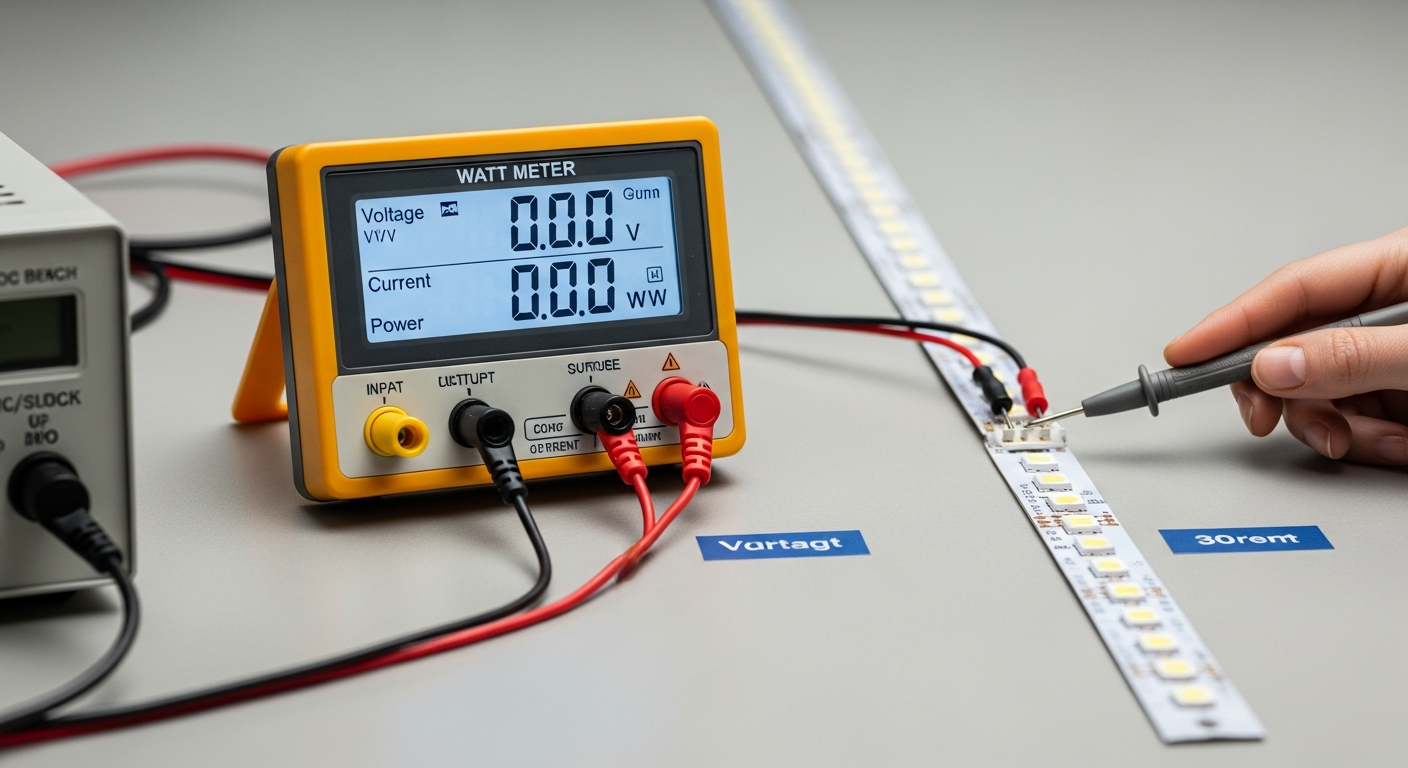
Getting the power supply wrong by just 20% can cause your LED strips to flicker, dim, or fail within months. This guide explains the calculation method used by professional LED installers, with worked examples you can apply directly.
Why the Calculation Matters
Power supply sizing is the most commonly mishandled part of LED strip installations. Most people just check that “the wattage is enough” and buy — without accounting for any safety margin.
The consequences of getting it wrong:
- Undersized PSU → runs at 100% load → overheats → capacitors fail in 6–12 months → must replace
- Exactly sized PSU (no headroom) → lifespan is 40–50% shorter than spec
- Wrong voltage (12V vs 24V mismatch) → strip is destroyed immediately on first power-up
- Oversized by a large margin → no harm, but you paid more than necessary
Three Numbers You Need to Know First
Before calculating, you need exactly 3 pieces of information:
1. Strip power draw (W/m) — on the product label or datasheet. Examples:
- SMD 2835 60 LED/m → 4.8 W/m
- SMD 5050 60 LED/m → 14.4 W/m
- COB 320 chip/m → 10 W/m
- COB 480 chip/m → 12–14 W/m
- COB 512 chip/m → 15–20 W/m
2. Total installation length (meters) — measure the actual run; don’t estimate
3. Strip voltage — 12V or 24V; your PSU output must match exactly
The Formula
Standard formula:
PSU Wattage = Strip (W/m) × Total Length (m) × 1.25The 1.25 multiplier = 25% safety margin — the professional standard. Reasons:
- A PSU running at 80% capacity runs significantly cooler and lasts much longer than at 100%
- Real-world efficiency is 85–93%, not the theoretical 100%
- Inrush current at startup is 1.5–2× steady-state draw
- Leaves capacity for future additions to the system
For 24/7 commercial operation (shops, signage), use 1.4 × multiplier (40% headroom) instead.
Step-by-Step Worked Examples
Example 1: Living Room Cove Lighting
- Strip: COB 24V 12 W/m
- Length: 10 meters
- Total load: 12 × 10 = 120W
- With 25% margin: 120 × 1.25 = 150W
- Choose: PSU 24V 150W
Example 2: Under-Cabinet Kitchen Lighting
- Strip: SMD 5050 12V 14.4 W/m
- Length: 3 meters
- Total load: 14.4 × 3 = 43.2W
- With 25% margin: 43.2 × 1.25 = 54W
- Choose: PSU 12V 60W (a plug-in adapter works for this scale)
Example 3: Retail Store — 24/7 Operation
- Strip: COB 24V 15 W/m
- Length: 30 meters
- Total load: 15 × 30 = 450W
- With 40% margin (24/7): 450 × 1.4 = 630W
- Choose: Two PSU 24V 350W (split the load) or one 650W unit
Quick Reference Cheat Sheet
Estimated PSU size (including 25% margin):
| Run Length | COB 10W/m | COB 15W/m | SMD 14.4W/m |
|---|---|---|---|
| 5m | 60W | 100W | 100W |
| 10m | 150W | 200W | 200W |
| 15m | 200W | 300W | 300W |
| 20m | 250W | 400W | 400W |
| 30m | 400W | 600W | 600W |
Common Mistakes to Avoid
- Never power a strip longer than 5m from a single injection point without dual feeding — even with a perfectly sized PSU, voltage drop will cause end-of-run dimming
- Don’t share a PSU across multiple loads (strip + security camera + router) without calculating the combined total
- Account for PSU aging — a 3–5 year old PSU may only deliver 70–80% of its rated wattage. Factor this in for upgrade projects.
- Don’t ignore feed wire resistance — long runs of small wire between PSU and strip also lose voltage. Use AWG 18 or larger.
- Install a fuse or DC breaker between the PSU and strip — sized to the PSU’s current output. This protects the PSU from short-circuit current flowing back through it.
Summary
The formula to remember: W/m × Length × 1.25 = minimum PSU wattage. Get this right and you’ll avoid the most common cause of premature LED system failure.
Browse quality power supplies in multiple sizes at Arumstores. View all power supplies.